
Finding a distributor is not the same as entering the Dutch foodservice market.
International suppliers often start their Dutch market entry by looking for a distributor, wholesaler or local sales partner.
But before choosing a sales channel, there is a more important question:
How does your target customer actually buy your type of product?
A food manufacturer, hospitality furniture supplier and professional equipment brand may all target the Dutch hospitality market, but they can require completely different routes to reach the customer.
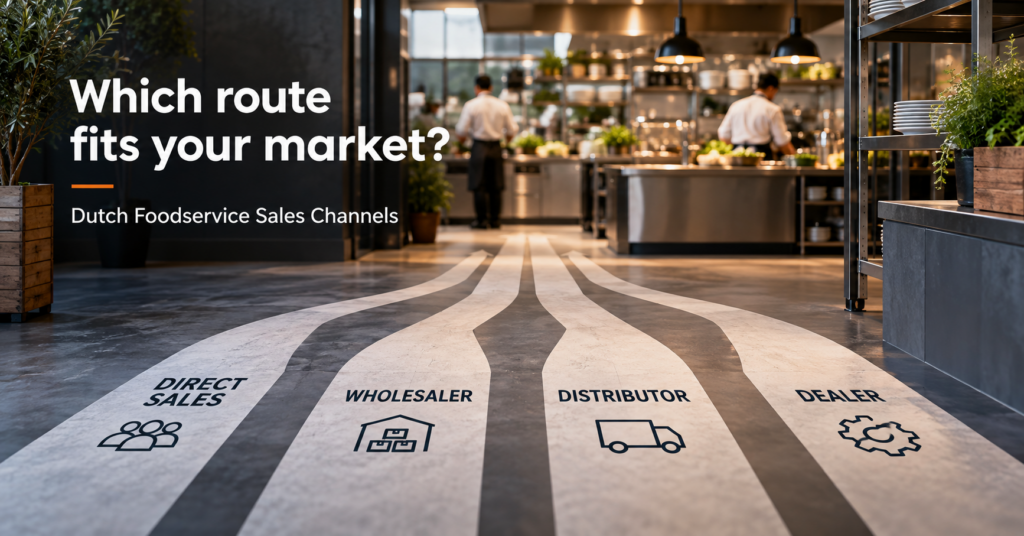
Depending on your proposition, the right route may be direct sales, a national wholesaler, a specialist distributor, a dealer or project partner, a purchasing organisation, or a combination of these.
This guide explains the main routes into the Dutch foodservice and hospitality market and how to determine which one fits your proposition.
Not Sure Where to Start in the Netherlands?
Before approaching distributors or potential customers, it can be useful to first determine which route actually fits your proposition.
Send us a short introduction to your company, product and objectives for the Netherlands. We will take an initial look at your proposition and the possible routes into the Dutch foodservice market.
Start with the Customer, Not the Distributor
The Dutch foodservice market includes restaurants, hotels, catering companies, leisure businesses, healthcare organisations, meal producers and multi-location hospitality groups.
But these organisations do not all purchase in the same way.
A restaurant may order most of its products through a foodservice wholesaler. A hotel group may negotiate contracts centrally. A large caterer may work with preferred suppliers and purchasing agreements. Furniture or equipment may be purchased through dealers, project suppliers or other specialised partners.
This means that your route to market should start with three questions:
Who uses the product?
Who makes or influences the purchasing decision?
How is this type of product currently purchased and delivered?
Only then does it make sense to decide which sales and distribution channel to pursue.
For a broader overview of the market structure, key players and purchasing behaviour, read our Dutch Foodservice Market Guide.
1. Direct Sales to Foodservice Operators
Selling directly means developing commercial relationships with the organisations that actually use your product.
Depending on your proposition, potential customers may include restaurant and hotel groups, caterers, leisure operators, holiday parks, healthcare organisations, meal producers or other professional foodservice organisations.
Direct sales can be particularly relevant when your product requires explanation, represents a significant investment or provides a clear operational or commercial advantage.
It can also be an effective way to validate your proposition in the Netherlands before investing in broader distribution.
Why direct sales can be valuable
Direct conversations give you first-hand information about the market.
You learn how potential customers perceive your proposition, what alternatives they currently use, how the category is purchased and which requirements matter in the buying decision.
Most importantly, you can start developing actual customer demand.
The challenge
Direct sales require commercial effort and market knowledge.
Knowing that a company could potentially use your product is not enough. You need to identify the right organisation, understand its purchasing structure and reach the person who actually influences or makes the decision.
And even when you sell directly, you may still require a Dutch logistics or distribution partner to fulfil orders.
Direct sales and distribution are therefore not necessarily competing strategies.
2. Foodservice Wholesalers
Foodservice wholesalers play an important role in the Dutch market.
Large companies such as Sligro, HANOS and Bidfood supply broad assortments to hospitality, catering, leisure and institutional customers. Regional wholesalers and wholesale groups also serve significant parts of the market.
For international suppliers, a wholesaler can provide established logistics, ordering infrastructure and access to an existing customer base.
But there is an important distinction:
Distribution Does Not Create Demand
Getting your product into a wholesaler’s assortment does not automatically mean that customers will start ordering it.
This is particularly important for suppliers without an established brand or existing customer base in the Netherlands.
Before approaching a wholesaler, ask:
> Which of their customers would realistically buy our product?
> What problem does our product solve?
> How does it differ from products already available?
> Is there already demand from Dutch operators?
> What sales volume could realistically be generated?
> Who will create that demand: us, the wholesaler or both?
A wholesaler becomes a much stronger potential route when there is a clear commercial reason for customers to order the product.
3. Specialist Distributors
A specialist distributor can be more suitable when your product requires category expertise, active sales support, technical knowledge or specialised logistics.
These companies may serve a smaller part of the overall foodservice market but have stronger relationships within a specific segment or product category.
That can be relevant for both food and non-food suppliers.
A specialist distributor may therefore offer less total market coverage than a national wholesaler, while providing significantly better access to the customers that actually matter to you.
The relevant question is not simply:
“How large is the distributor?”
It is:
“How strong is this distributor within the market we actually want to reach?”
4. Dealers and Project Partners
For many non-food suppliers, a traditional foodservice wholesaler may not be the most logical route at all.
This can apply to categories such as:
> furniture
> professional kitchen equipment
> tableware
> technical equipment
> interior products
> professional appliances
> certain cleaning and facility solutions
These products may be purchased through specialist dealers, kitchen specialists, project suppliers or as part of larger hospitality projects.
The organisation using the product may therefore not be the only party influencing its selection.
Designers, consultants, contractors, dealers, kitchen specialists and project suppliers can all play a role.
For an international supplier, identifying these influencers and commercial partners can sometimes be more important than identifying the largest hospitality operators.
5. Purchasing Organisations and Commercial Networks
Some Dutch foodservice companies participate in purchasing organisations, franchise structures, commercial networks or centrally negotiated supplier programmes.
Larger hospitality groups may also centralise purchasing across multiple locations.
These structures can provide suppliers with access to significant purchasing volume, but they can also create barriers for new entrants.
Existing agreements may include preferred suppliers, annual rebates, commercial conditions or established distribution arrangements.
A new product can therefore be attractive on price or quality and still face resistance because switching affects other parts of the purchasing structure.
For an international supplier, understanding why an organisation buys through its current structure is therefore just as important as knowing which products it purchases.
6. Combining Sales and Distribution Channels
You do not necessarily have to choose one route.
In many cases, sales and distribution can be separated.
For example, you could develop relationships directly with hotel or restaurant groups while orders and deliveries are handled through an existing wholesaler.
You could also use a specialist distributor for one market segment while approaching several larger operators directly.
Another possibility is to establish demand among Dutch customers first and use that demand when discussing distribution with a wholesaler.
This creates an important distinction:
The company that sells your product does not always have to be the company that delivers it.
Separating these functions can create additional routes into the Dutch market.
Which Sales Channel Fits Your Product?
Before selecting a route, answer the following five questions.
1. Who actually uses the product?
Define your target customer as precisely as possible.
“Hospitality” or “foodservice” is usually too broad.
A product intended for hotel groups can require a completely different approach from a product intended for independent restaurants, healthcare kitchens or meal producers.
2. Who makes the purchasing decision?
The user, buyer, decision-maker and distributor may all be different parties.
Determine who specifies the product, who influences the decision, who approves the purchase and who ultimately places the order.
3. How much active selling does the product require?
Some products can be relatively easily added to an existing assortment.
Others require demonstrations, samples, technical explanation, consultation or a clear financial business case.
The more active selling a product requires, the less likely it is that distribution alone will generate sufficient demand.
4. What does the distribution model require?
Consider factors such as:
> order frequency
> minimum order quantities
> shelf life
> temperature requirements
> storage
> delivery locations
> installation
> service
> after-sales support
A commercially attractive partner is of limited value if the operational model does not work.
5. Where will demand come from?
This may be the most important question of all.
If a Dutch distributor or wholesaler lists your product tomorrow, who is going to order it?
If there is no clear answer, developing customer demand may need to come before building large-scale distribution.
Should You Find a Distributor Before Finding Customers?
For companies entering the Netherlands for the first time, finding a distributor can feel like the market-entry problem has been solved.
In reality, the distributor still needs customers who want the product.
For some propositions, it can therefore be more valuable to first speak with a focused number of relevant Dutch operators.
These conversations can help determine:
> whether there is genuine demand for the proposition
> which product characteristics matter to Dutch customers
> how your pricing is perceived
> which alternatives are already being used
> how the category is currently purchased
> which wholesalers or distributors customers already work with
This information can significantly improve the next step.
Instead of approaching a potential distribution partner with only a product catalogue and a request for representation, you can discuss a more concrete market opportunity.
Food and Non-Food Products Require Different Routes
The term foodservice market does not mean that every supplier needs to sell food.
Restaurants, hotels, caterers, leisure operators and other professional foodservice companies purchase a wide range of products.
These include food and beverages, but also packaging, cleaning products, tableware, workwear, furniture, kitchen equipment and other operational supplies.
The appropriate route to market can differ substantially between categories.
A food manufacturer may require temperature-controlled distribution through a foodservice wholesaler.
A tableware supplier may work through specialist wholesalers or dealers.
An equipment manufacturer may require a partner capable of installation and after-sales service.
A hospitality furniture supplier may find opportunities through project partners, designers or direct relationships with hotel and restaurant groups.
Your market-entry route should therefore follow the purchasing structure of your category, not a generic foodservice model.
Common Mistakes When Entering the Dutch Market
A common mistake is approaching the largest distributor first simply because it offers the greatest theoretical market coverage.
Another is assuming that a distribution agreement will automatically generate sales.
International suppliers can also spend significant time building lists of Dutch companies without determining whether those organisations are commercially relevant.
And suppliers sometimes focus on the end customer while overlooking the organisations and people that influence the purchasing decision.
A more effective sequence is:
Target customer → purchasing structure → market demand → sales channel → distribution
rather than:
Find distributor → list product → hope customers buy it
The difference fundamentally changes how you approach the market.
A Practical Approach to Selecting Your Dutch Sales Channel
Before investing significantly in the Netherlands, we recommend building a simple market-entry picture.
Start by identifying the Dutch segments where your proposition is most relevant.
Then determine how those organisations currently purchase your category and who influences the decision.
From there, identify the sales channels and distribution routes that match that purchasing structure.
Only after that should you build a focused list of potential operators, distributors, wholesalers, dealers or commercial partners.
The objective is not to identify every company that could theoretically buy or distribute your product.
The objective is to identify the shortest realistic route between your proposition and the right Dutch customers.
Not Sure Which Route Fits Your Product?
Spectofood helps international suppliers determine how their proposition fits within the Dutch foodservice and hospitality market.
We look at your product, target customers, purchasing structure and potential routes to market before identifying the organisations and commercial contacts that are relevant.
Depending on your proposition, this may involve direct operators, wholesalers, distributors, purchasing organisations, dealers, project partners or a combination of these.
Request a Dutch Market Entry Quick Scan
Are you considering entering the Netherlands but unsure where to start?
Send us:
> a short description of your company and products
> the markets or customer segments you currently serve
> your current position in the Netherlands, if any
> what you want to achieve in the Dutch market
I will take an initial look at your situation and let you know whether I see a relevant route for further discussion.
Email: info@spectofood.nl
Frequently Asked Questions
Do I need a distributor to enter the Dutch foodservice market?
Not necessarily. Depending on your product and target customers, direct sales, a foodservice wholesaler, specialist distributor, dealer or project partner may be more suitable. In some cases, a combination of direct sales and local distribution works best.
What is the difference between a foodservice wholesaler and a distributor in the Netherlands?
Foodservice wholesalers typically offer a broad assortment and established logistics to many hospitality and foodservice customers. Specialist distributors often focus on particular product categories, brands or customer segments and may provide more active sales and market-development support.
Should I find Dutch customers before looking for a distributor?
For some suppliers, this can be a strong approach. Initial conversations with potential customers can help validate demand, pricing and purchasing requirements. They can also show which wholesalers or distributors your target customers already use.
Can international non-food suppliers use the same sales channels?
Not always. Products such as furniture, equipment, tableware, cleaning products and other hospitality supplies can follow different purchasing routes. Dealers, project suppliers, specialist distributors or direct relationships with hospitality groups may be more relevant than traditional foodservice wholesalers.
How can Spectofood help me choose the right route to market?
Spectofood helps international suppliers understand how their proposition fits within the Dutch foodservice and hospitality market. We can help evaluate target segments, purchasing structures and potential sales channels, and identify relevant operators, wholesalers, distributors or other commercial partners.
Request a Dutch Market Entry Quick Scan
Email: info@spectofood.nl
About the author
Jurrien Koelewijn is an independent foodservice procurement consultant and founder of Spectofood. He works with hospitality companies, caterers and food producers in the Netherlands and supports international suppliers looking to understand and develop their position in the Dutch foodservice and hospitality market.